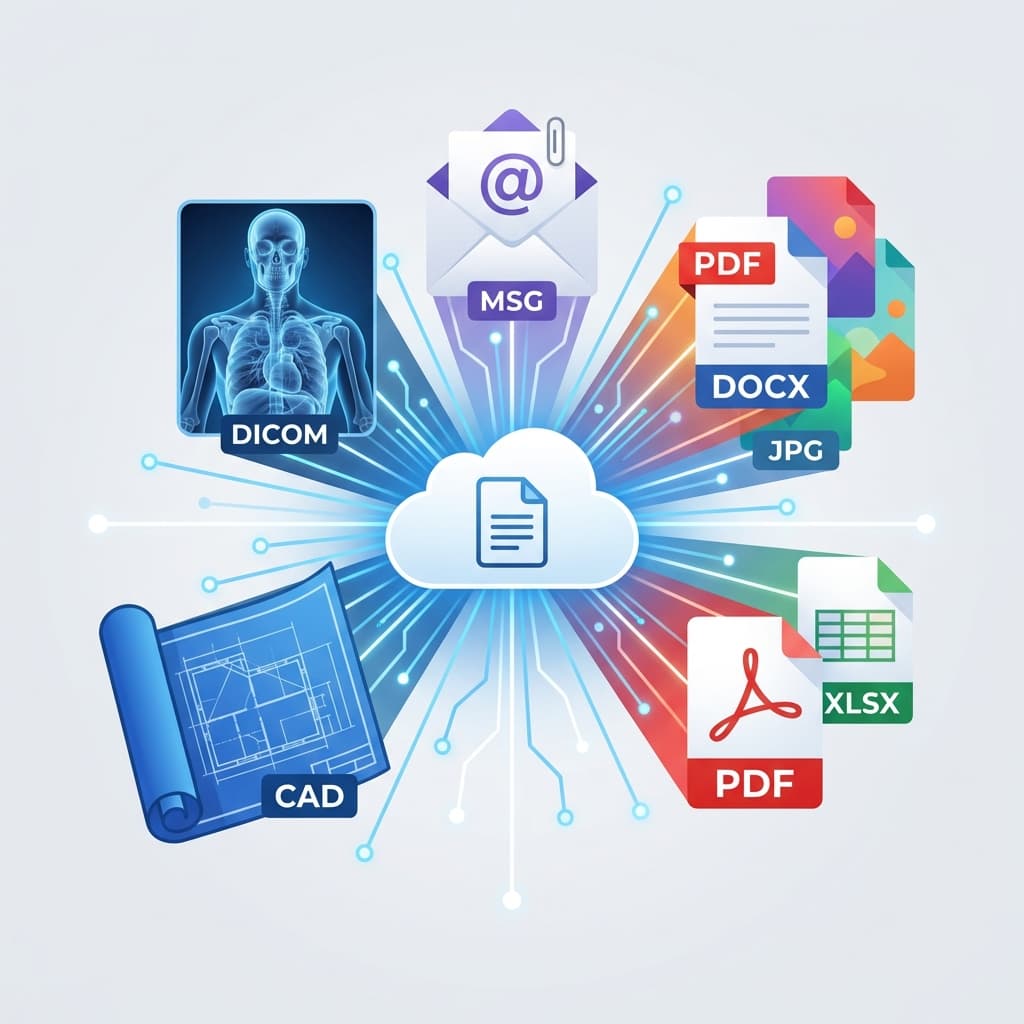
PDF and Office files are the easy part. The files that stop people are the ones whose only reader costs money: a DWG that wants AutoCAD, a PSD that wants Photoshop, an MSG that wants Outlook, a DICOM study locked inside a hospital workstation.
Engineering and architecture drawings
DWG, DXF and DGN open at CAD Viewer, up to 10 MB. Layers, line weights, hatches and dimension text render from the drawing data, not from the preview thumbnail stored in the file, and layers switch off one at a time so you can read the walls under the hatching. No AutoCAD licence anywhere in the process.
Medical imaging belongs to the SDK, not to this site
DICOM is the standard for X-rays, CT and MRI studies, and it is normally locked behind a PACS workstation. Doconut renders .dcm and .ima through a separately licensed DICOM plugin for the .NET SDK — code you run inside your own application, behind your own authentication.
It is deliberately absent from the free viewers. A public upload page with no accounts is the wrong place for patient studies, so the free tool refuses those two extensions. If DICOM is your case, the starting point is Doconut.com, not this page.
Email archives
MSG, EML and EMLX open at Email Viewer, up to 10 MB. Body, headers and attachments render in the browser, and each attachment is listed and viewable on its own. No Outlook, no import step, no mail client configured.
Where the line falls
One renderer, one upload box: 70+ extensions across PDF, Office, CAD, Visio, Project, PSD, email, EPUB and the image formats, each viewer with its own size ceiling. Everything above that line — DICOM, embedding in your own product, files that may not leave your network — is the SDK.
Free viewers for the formats above: OnlineDocumentViewer.com. The .NET library behind them, DICOM plugin included: Doconut.com.